The Music of Persia – A Thousand-Year-Old World of Sound Between Tradition and Diversity
The music of Persia is one of the oldest living musical traditions in the world. Its roots go back thousands of years, reaching into the eras of Elam, the Achaemenids, and especially the Sassanids. Even in those ancient empires, music was an essential part of social, spiritual, and artistic life. Names such as Barbad, the renowned musician at the court of Khosrow Parviz, remain part of Iran’s cultural memory to this day. His system of seven royal modes, thirty subsidiary melodies, and 360 musical pieces is considered one of the historical foundations of today’s Persian musical system.
Persian classical music, known today as traditional Iranian music, is based on the Radif — a repertoire of melodies passed down orally through generations and recognized by UNESCO in 2009 as an Intangible Cultural Heritage. The Radif forms the heart of Persian music and consists of hundreds of melodic units called Gusheh, organized within a complex modal structure.
The foundation of this music lies in the seven main Dastgahs: Shur, Mahur, Homayoun, Segah, Chahargah, Nava, and Rast-Panjgah. Alongside them are several Avaz systems such as Dashti, Afshari, Bayat-e Tork, Abu Ata, and Bayat-e Esfahan, each carrying its own emotional and sonic atmosphere. Unlike Western music, where harmony often takes center stage, Persian music is built around melody, improvisation, and subtle microtonal intervals, giving it its distinctive depth and delicacy.
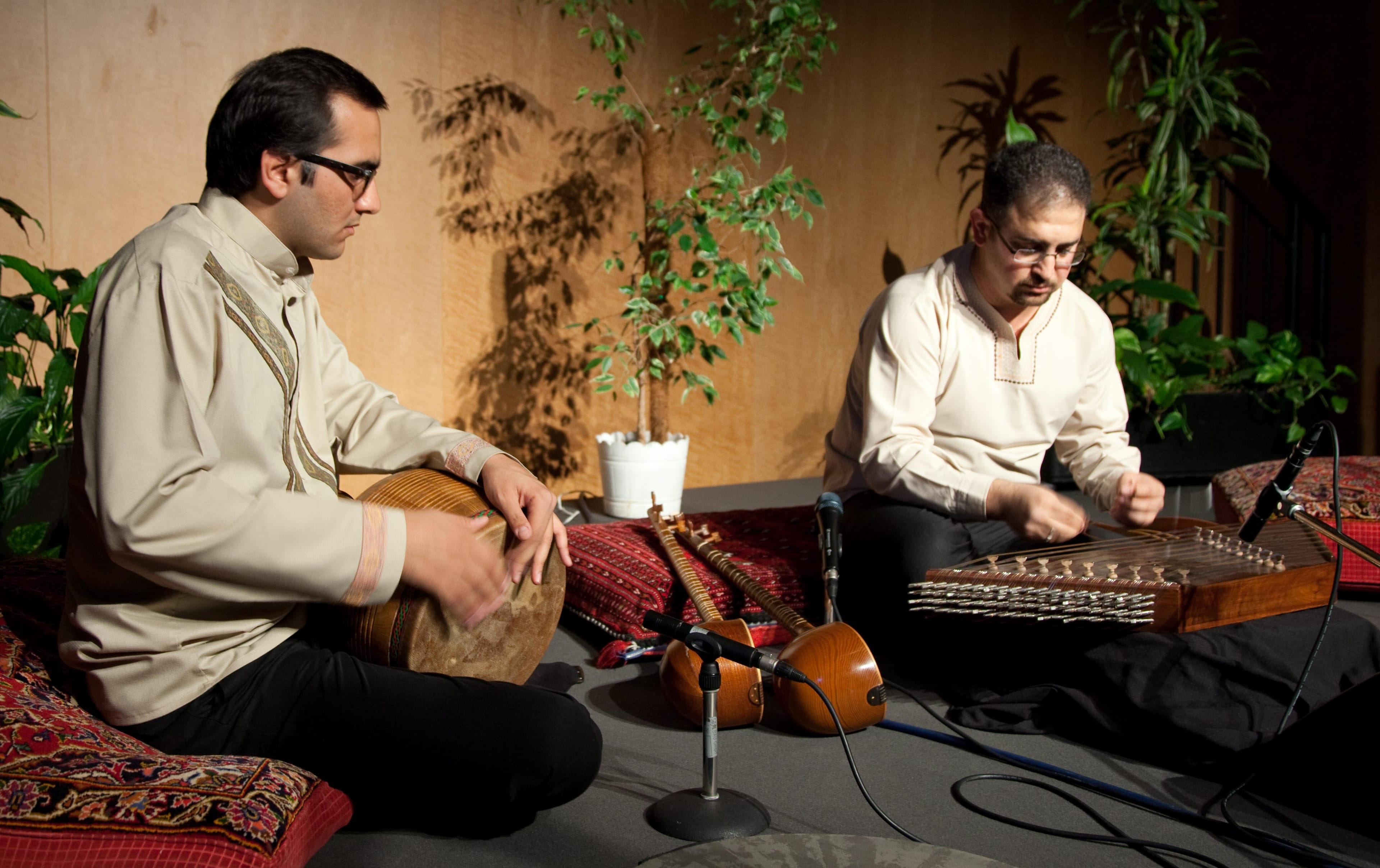
Traditional Persian music is performed on instruments such as the Santur, Tar, Setar, Kamancheh, Ney, Tombak, Daf, Oud (Barbat), Tanbur, and Qanun. Singing holds a central role, deeply connected to Persian poetry. The works of Hafez, Saadi, Rumi, Attar, and Ferdowsi often form the poetic foundation of many compositions.
Yet the music of Iran is far more than its classical Persian tradition. Iran is a multi-ethnic land with extraordinary musical diversity. Every region, language, and culture has preserved its own musical identity.
Kurdish music in western Iran is among the deepest and most spiritual musical forms of the country. It is rich in epic storytelling, mystical poetry, and rhythmic dances, with instruments such as the Tanbur, Daf, and Sorna playing an important role.
Luri music from Lorestan and Bakhtiari is deeply tied to nature, tribal life, and heroic tales. Its melodies are often both melancholic and powerful, shaped strongly by the Kamancheh and local vocal traditions.
Baluchi music in southeastern Iran has its own unique sonic world, with complex rhythms and trance-like structures. Instruments such as the Sorud, Benju, and Doneli are characteristic of this region, reflecting connections to Indian and Central Asian traditions.
Azerbaijani music in northwestern Iran is closely related to the Mugham tradition and lives strongly in the art of the Ashiqs — traveling singers and storytellers who perform tales of love, history, and life with the Saz.
Turkmen music in northeastern Iran is marked by epic songs and the Dotar and is among the oldest nomadic musical traditions in the country.
Gilaki and Mazandarani music from northern Iran reflects the landscapes of the Caspian Sea, rain, forests, and village life. Its melodies are often gentle, narrative, and rhythmically rich.
Khorasani music is one of the richest musical traditions of Iran, especially through the art of Dotar playing and the music of the Bakhshi masters, which carries deep spiritual and storytelling significance.
In southern Iran, Bandari music is known for its energetic rhythms and strong influences from Africa, Arabia, and India. Fast beats, Ney-Anban, percussion, and dance are its defining features.
Alongside these major traditions, smaller ethnic groups and communities also hold an important place in Iran’s musical history.
The music of the Qashqai, a Turkic-speaking nomadic people in southern Iran, is deeply connected to migration, nature, love, memory, and tribal history.
The music of the Talesh in northwestern Iran carries a calm and nature-bound character, reflecting forests, mountains, and the Caspian Sea.
The music of the Tat communities also belongs to the ancient cultural voices of Iran, preserving traces of old Iranian languages and traditions.
The Armenian and Assyrian communities of Iran also play a significant role in this diversity. Their music is strongly connected to church chants, celebrations, family gatherings, and their own languages. Armenian music in Iran has preserved both sacred and folk forms, while Assyrian music carries a deep ancient heritage through its melodies, dances, and liturgical songs.
The Jewish music of Iran is another important, often less recognized, part of this rich diversity. Jewish communities have lived for centuries in cities such as Isfahan, Yazd, Tehran, Hamedan, and especially Shiraz. In Shiraz, Jewish music has long been closely tied to religious ceremonies, weddings, family gatherings, and local musical traditions. Many Jewish musicians adopted elements of Persian music while performing within their own religious and cultural contexts. This created a unique connection between Persian melody, Hebrew texts, local dialects, and the musical atmosphere of Shiraz.
The music of the Arab communities in Khuzestan, along with many other local traditions, also forms an important part of this cultural mosaic.
For this reason, the music of Iran is not simply “Persian music”; it is a vast cultural universe where history, language, religion, landscape, and identity meet. From the deep improvisations of the Radif to the vibrant rhythms of regional traditions, it reveals a diversity unlike any other.
These larger and smaller communities show that the music of Iran does not consist of a single voice. It is a layered fabric of languages, memories, beliefs, landscapes, and ways of life. This diversity is what makes the music of Persia and Iran so rich: each community contributes its own sound, and together they create a great musical mosaic.
The SAMA Ensemble sees itself as part of this living tradition. In its artistic work, it brings together Persian classical music with regional and contemporary influences, creating a space where past and present, tradition and innovation, meet in dialogue.