Other
Violin
Summary
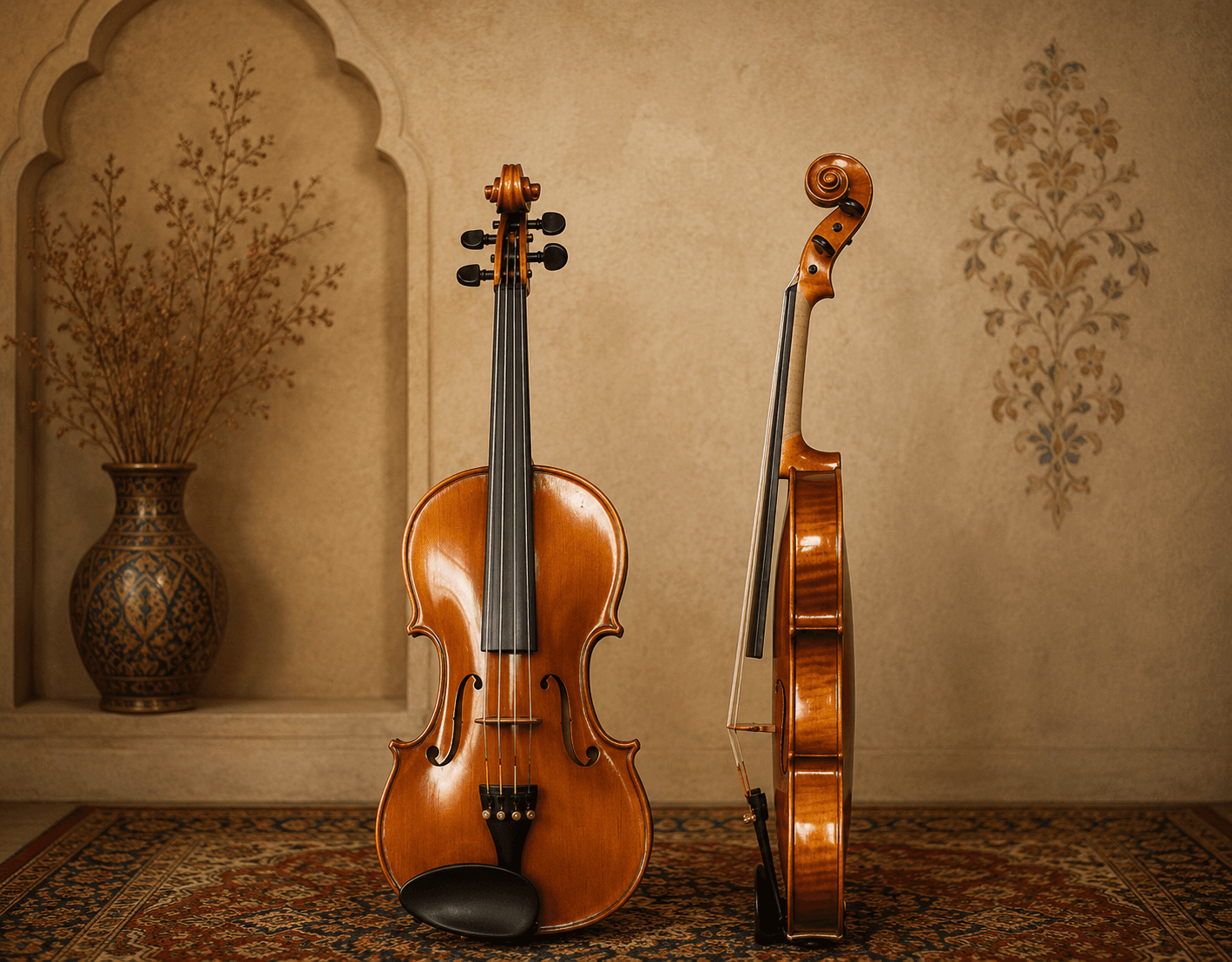
The Persian violin combines the technical possibilities of the violin with the melodic language and ornamentation of Persian music. Through a unique performance tradition, it has developed its own distinctive sound and has become one of the most important instruments in Iranian music today.
Description
The Violin in Persian Music – A Bridge Between Traditions
Originally a European instrument, the violin was introduced to Iran during the late nineteenth century and soon became one of the most influential instruments in Persian music. Its wide range, expressive capabilities, and flexibility made it particularly suitable for the performance of Persian classical music.
Over time, Iranian musicians developed a distinctive performance tradition known today as the “Persian violin style” or “Persian violin method.” In this approach, the violin is adapted to perform the scales, microtones, ornaments, and melodic nuances that characterize Persian music. As a result, the Persian violin has acquired a unique musical identity that differs significantly from the Western classical tradition.
The Persian violin is especially admired for its ability to convey delicate ornamentation, expressive phrasing, and emotional depth. Its warm and lyrical tone has made it a favorite instrument for solo performances as well as ensemble playing.
Many influential musicians contributed to the development of this tradition, including Hossein Yahaghi, Abolhasan Saba, Ali Tajvidi, Homayoun Khorram, Parviz Yahaghi, and Asadollah Malek. Their work helped shape the Persian violin style and left a lasting impact on Iranian music.
Today, the Persian violin remains an important voice in classical Persian music, contemporary compositions, film music, and intercultural projects. It serves as a bridge between a globally recognized instrument and one of the world’s richest musical traditions.