Other
Oud (Barbat)
Summary
The Oud (Barbat) is one of the oldest string instruments in the world and a cornerstone of Persian and Middle Eastern music. Its warm, deep, and expressive sound makes it a powerful instrument for melodic and emotional expression. The Oud represents a rich musical heritage that spans centuries.
Description
Oud (Barbat) – An Ancient Heritage of Persian Music
The Oud, historically known in Persia as the Barbat, is one of the oldest and most influential string instruments in the world. With its warm, deep, and resonant tone, it has shaped the musical traditions of the Middle East, North Africa, and beyond for centuries. Many music historians consider the Persian Barbat to be one of the principal ancestors of the European lute and an important contributor to the development of string instruments worldwide.
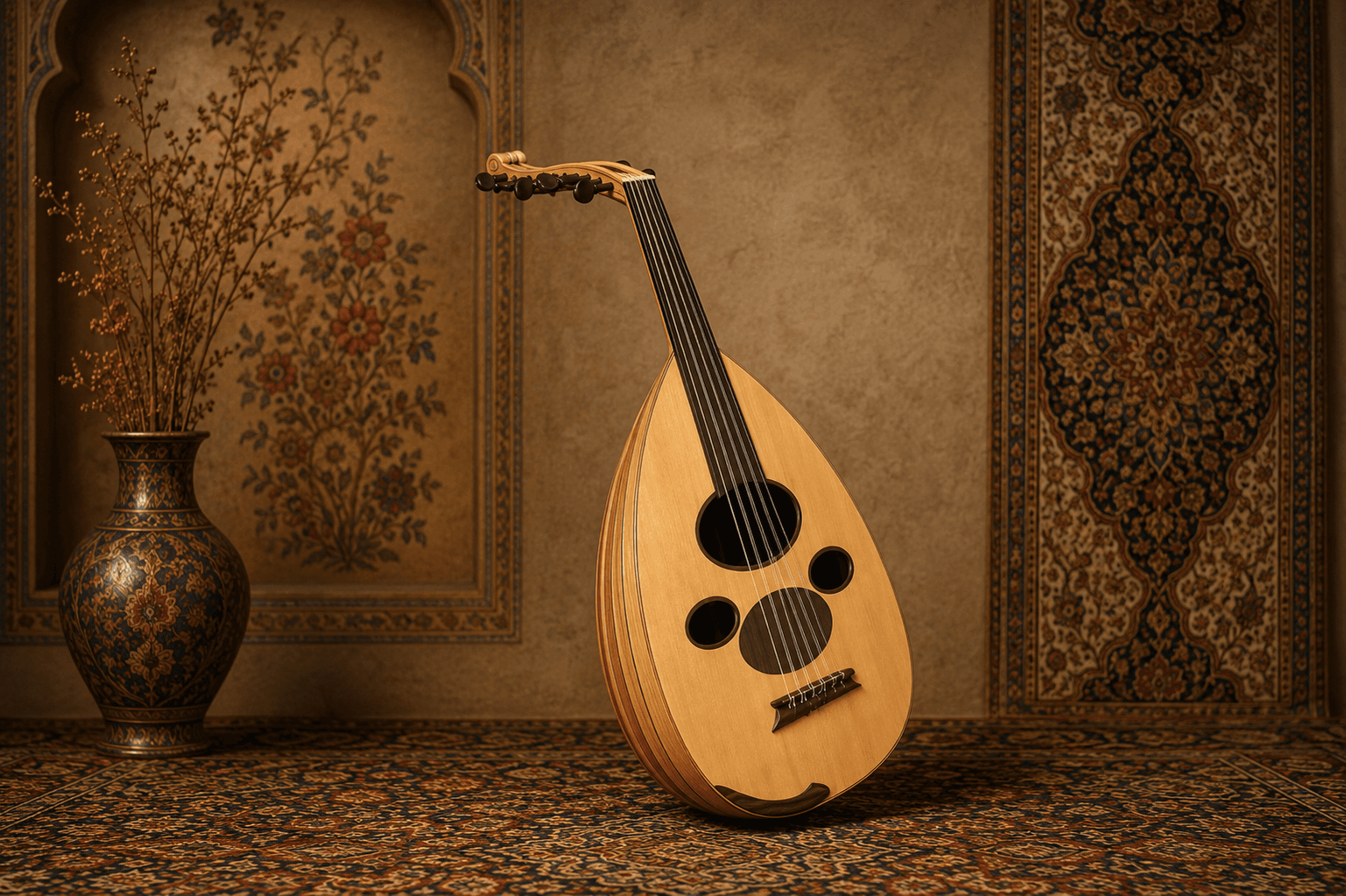
The Oud features a large pear-shaped body, a short neck, and multiple strings played with a plectrum. Unlike many string instruments, it has no frets, allowing performers to produce the subtle intervals and microtones characteristic of Middle Eastern music. Its sound is rich, warm, and expressive, making it ideal for both lyrical melodies and virtuosic passages.
The origins of the Barbat can be traced back to ancient Persia. Historical evidence suggests that instruments of this type were widely known before the Islamic era. During the Sasanian period, the Barbat was among the most prestigious court instruments, and the legendary musician Barbad is often associated with it. Over the centuries, the instrument spread throughout the Islamic world and eventually influenced the development of numerous lute-type instruments in Europe.
Today, the Oud enjoys renewed popularity in Persian music and beyond. It is widely used in solo performances, ensembles, and orchestras, admired for its expressive depth and rich tonal character. At the same time, it plays an important role in contemporary and intercultural musical projects around the world.
With its ancient history and distinctive voice, the Oud represents the cultural richness and musical heritage of Persia and the broader Middle East. It continues to connect past and present, inspiring musicians and audiences across cultures and generations.